
The Impact of GAIN on Access to Graduate Education for African Students
Graduate programs in economics draw students from all over the world. The three of us — Samira, Frank, and Konstantin — are all pursuing graduate studies on a different continent from where we grew up. And yet almost none of our peers or professors come from a country in Africa. Over the past three years, we studied this gap more systematically and evaluated the impact of GAIN's mentorship program on the representation of African scholars in graduate economics. In short: GAIN significantly lowers the barriers African students face when applying to graduate programs abroad, but important limitations for access remain that we highlight below.
The GAIN program starts with a webinar series on applying to PhD, Master’s, and Predoc programs in economics and closely related fields. The webinars are followed by a comprehensive application-support program involving one-on-one mentoring, funding for application fees, and help with standardized tests, among other things. Once students are enrolled in graduate school, GAIN continues to support participants through its alumni network.
African students make up a small share of the doctorates awarded to international students in North America and Europe
Economics is one of the most international fields at the graduate level. In the United States, about two-thirds of economics doctorates awarded between 2000 and 2019 went to international students. Only 2.1% went to African citizens. That is a strikingly small share relative to Africa's population, and it likely shapes the kind of research being produced and published in leading journals about countries in Africa.
At the same time, fewer people complete higher education on the African continent, and education systems are less developed or recognized than those in higher-income countries. This affects both the supply of competitive candidates and the ability of strong candidates to signal their skills. GAIN is an application-stage program, so it works with the existing pipeline of Bachelor’s or Master’s graduates across Africa. Our study answers the question whether the relatively small share of African students in graduate economics mainly reflects what happens before the application stage, or whether the application process itself is contributing to this lack of representation down the line.
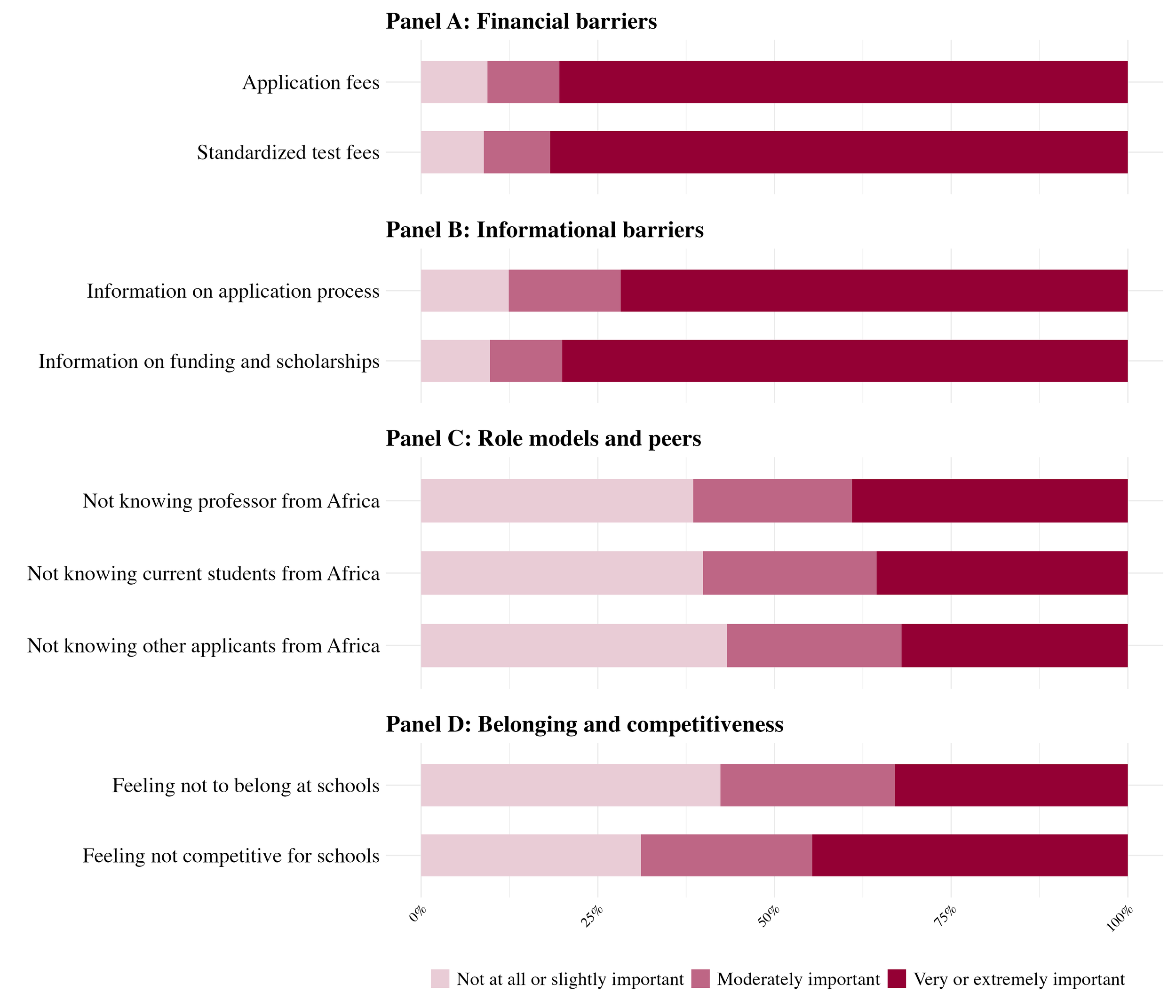
Students across Africa face many barriers at the application stage, including outsized costs relative to local incomes, knowledge gaps, and signaling frictions
The figure shows responses from the prospective applicant sample to the question "For each of the following potential barriers, to what extent do you agree or disagree about their importance or relevance for students from your country of origin to successfully apply to graduate school (Masters or PhD) in Europe or North America?" Bars show the share of answers on a five-point Likert scale ranging from "not at all important" to "extremely important," grouping the bottom two and top two choices.
The most obvious barrier is the cost of applying. We surveyed GAIN mentors as part of the study, and they recommend around 15 applications per candidate. Adding up application fees, GRE and TOEFL costs, score reports, and transcript evaluations, the total comes to roughly $2,400; this is about 85% of the average annual income of prospective applicants in the GAIN webinars. Around 80% of those webinar participants stated that application fees, test fees, and information about funding or scholarships are very important barriers for them.
Informational and signaling frictions add to the financial constraints. On the informational side, we find real knowledge gaps around the application process, especially on what we think of as a "hidden curriculum": the kind of knowledge that is passed on more informally and harder to gather without a network of students or faculty in higher-income countries. Webinar participants got 52% of application-process true/false questions right, compared with 81% for mentors. Webinar participants would recommend applying to about 6 programs on average whereas mentors recommended 15. On the signaling side, nearly 80% of mentors stated admissions committees discount African institutions because they are not familiar with them, and 92% said letter writers from African institutions carry less weight with committees abroad.
The GAIN mentoring program increases applications, offers, and enrollment, but the costs of attendance remains a barrier for Master’s programs
The GAIN program is designed to alleviate these barriers. First, the webinars directly target the knowledge gap. The subsequent mentoring program then pairs applicants with PhD students, faculty, or other economics researchers for one-on-one mentoring, covers multiple application fees and standardized test costs, and builds an ongoing peer network, among other support measures. The mentoring program has become competitive with strong applicants outnumbering available slots. In partnership with us, GAIN randomized admission among a "middle group" of competitive candidates, and our causal analysis follows the candidates who were randomly admitted (treated) versus randomly not admitted (control). Our study pools the program cycles in 2023/24 (cohort 1) and 2024/25 (cohort 2).
Figure 2 shows our headline results. While about 60% of those in the control group applied to at least one graduate program, 88% in the treatment group applied, a large treatment effect of the mentoring program. Similarly, about 40% in the control group receive at least one admissions offer compared with 67% in the treatment group. Finally, the mentoring program has a large effect on eventually attending a graduate program: while about 16% of the control group are enrolled, almost 33% in the treatment group are. These sizable causal effects show that the GAIN program addresses first-order application-stage barriers and how these barriers contribute to the current underrepresentation of African scholars.
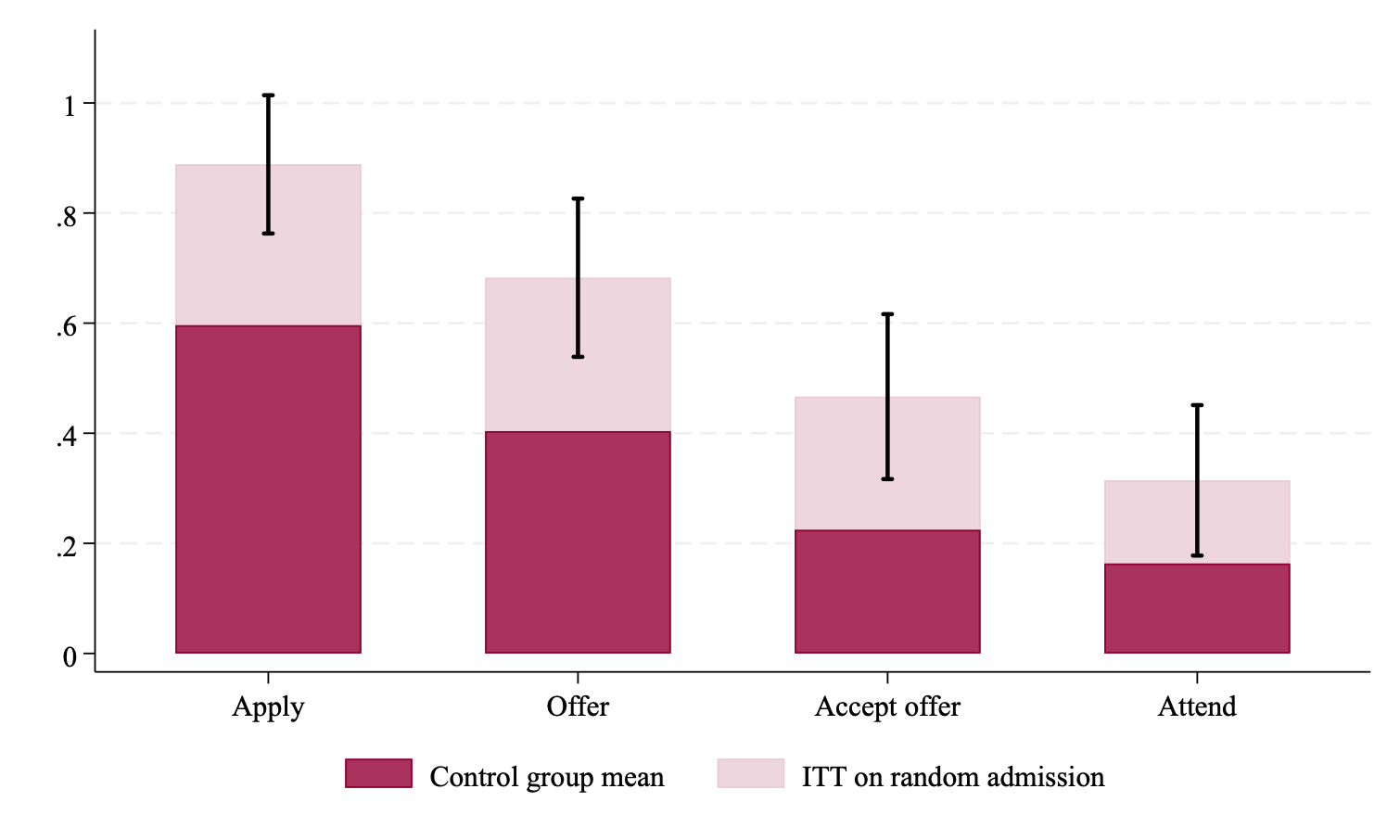
Mentoring program treatment effects on applications, offers, and attendance
The figure shows intent-to-treat effects of the application-support program on the propensity of submitting at least one application, receiving at least one offer of admission, accepting at least one offer of admission, and attending a graduate program. Vertical black lines show 90% confidence intervals.
The average (intent-to-treat) effects in Figure 2 mask important variation by students' prior preparation. When applicants apply to the mentoring program, GAIN groups them internally based on whether they look competitive for PhD or Master’s programs. This assessment was only communicated with mentors in cohort 1 and was non-binding; in cohort 2, it was communicated with mentees as well and had a more binding character. Both MA and PhD groups see sizable gains in applications and offers. But the enrollment effect is driven almost entirely by PhD programs and by candidates who looked competitive for PhDs at baseline. In contrast, the additional Master’s offers are unfunded and the cost of attendance is prohibitive for most applicants.
We delve deeper into mechanisms in the paper. A core mechanism is the easing of the financial constraint. Out-of-pocket application spending among treated applicants declined by about $256 per person, compared with $423 spending among applicants in the control group (despite treated students applying to more programs). We do not see evidence that the program strengthened application materials in the short run, or that treated students applied to differently-ranked schools. However, we find evidence consistent with an important role for mentors. Whether mentees enrol is positively correlated with mentors’ knowledge of the application process, and mentees are more likely to enrol when their mentor put in a word for them somewhere or wrote them a letter of recommendation.
Universities can lower the cost of applying for students from lower-income countries, and researchers can help strengthen the pipeline into top graduate programs
There are some very concrete measures universities can take to lower application-stage barriers:
Provide application fee waivers more systematically for students from lower-income countries and make it easier to request them.
Accept unofficial standardized test scores at the application stage and only require costly official score reports for verification after admission.
Waive English-language testing for applicants who have already studied in English, including at the Master’s level.
Programs could be clearer about which components of the application matter the most in admissions, as well as whether and where funding is available.
Ease the transition to graduate school through relocation and visa support to support enrolled students to be able to attend
Finally, while GAIN is effective at the application stage, especially for PhD programs, it is ultimately treating symptoms of deeper problems in the pipeline leading up to graduate education. Tackling those upstream deficits is important. Strengthening undergraduate and graduate training at African universities would have a first-order impact on access and representation in academia. Predoctoral fellowships offer a faster route to building candidates' competitiveness, but they depend on faculty being willing to train candidates rather than intensively selecting on prior research and coding experience. Exchange programs can open doors and create real research collaborations along the way.
You can read the full study here. We appreciate any comments and hope the study contributes to a discussion on how to make access to the economics profession more equitable.
Samira Adhar is a PhD student at Boston University, Frank Odhiambo is a postdoctoral researcher at the University of Göttingen, and Konstantin Poensgen is a PhD student at Harvard University. Frank is a co-founder of GAIN, has led various seminars for GAIN, and has co-organized the mentoring program in the past. Samira and Konstantin have previously co-led the mentoring program, and Konstantin has chaired webinars for GAIN.